
Homeschooling With Games: 35 Games We Actually Used for Learning
This guide contains affiliate links, which means The Gathered Guide may earn a small commission if you make a purchase – at no additional cost to you.
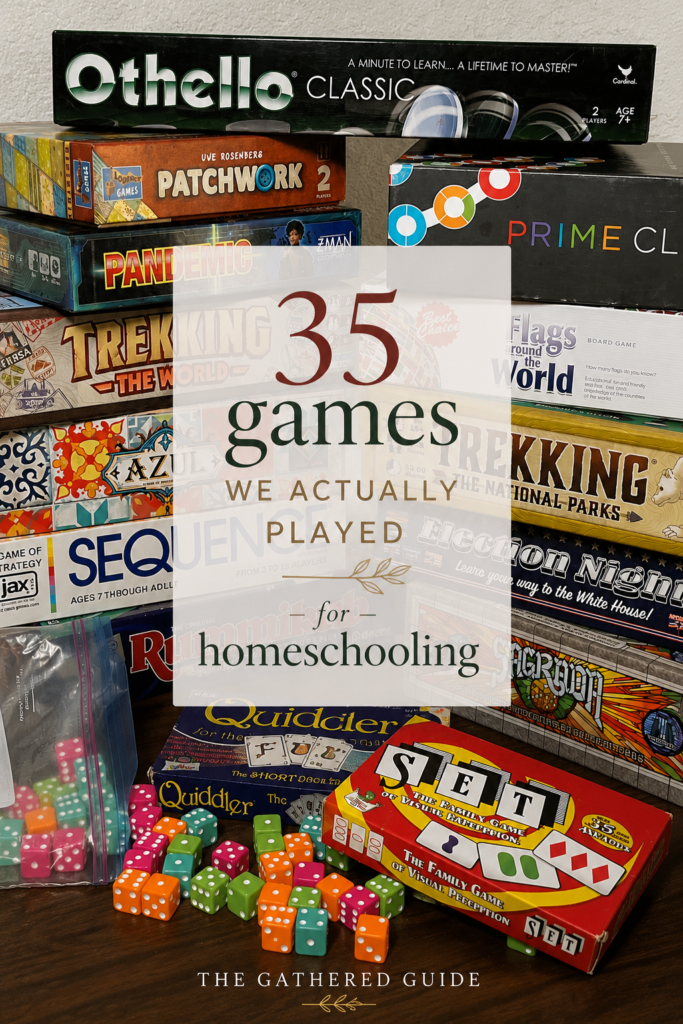
One of my favorite things about homeschooling was realizing that learning didn’t always have to look like school.
Sometimes math looked like sitting around the table trying to manage a budget. Geography looked like planning your way around the world. Vocabulary happened during a game nobody wanted to stop playing. Strategy, logic, storytelling, problem-solving, and even history could all happen with a game spread across the table.
Over the years, we collected a lot of games.
Some were specifically designed to teach a subject. Others were simply really good games that happened to exercise skills I wanted my kiddo using anyway. Homeschooling an only child with games can be tough… there were usually only 2 players. Most of these games are 2+ player games and work well with only 2 people.
If you’d like to add more game-based learning to your homeschool, here are some of the ones that earned space on our shelves.
The Hardest Part of Gameschooling? Learning the Game
One thing nobody tells you about using games for homeschooling is that sometimes the hardest part is simply figuring out how to play them.
Some rulebooks are great. Others somehow make a fairly simple game sound like you’re preparing to negotiate an international treaty.
We eventually discovered that YouTube was often the fastest solution. We’d search for a quick how-to-play video, watch someone actually set up the game and take a few turns, and suddenly the rulebook made a lot more sense.
My kiddo also happens to love figuring things out, so eventually I started handing that job over to her. She’d learn the game first and then teach it to me.
Looking back, that was learning too.
To teach me the game, she had to understand the rules herself, organize the information, explain it clearly, answer my questions and sometimes figure out where I had misunderstood something.
So even before we started playing the supposedly “educational” game, learning how to play had already become part of the education.
Math & Money Games
Math is probably one of the easiest subjects to move away from a worksheet because numbers are naturally part of so many games.
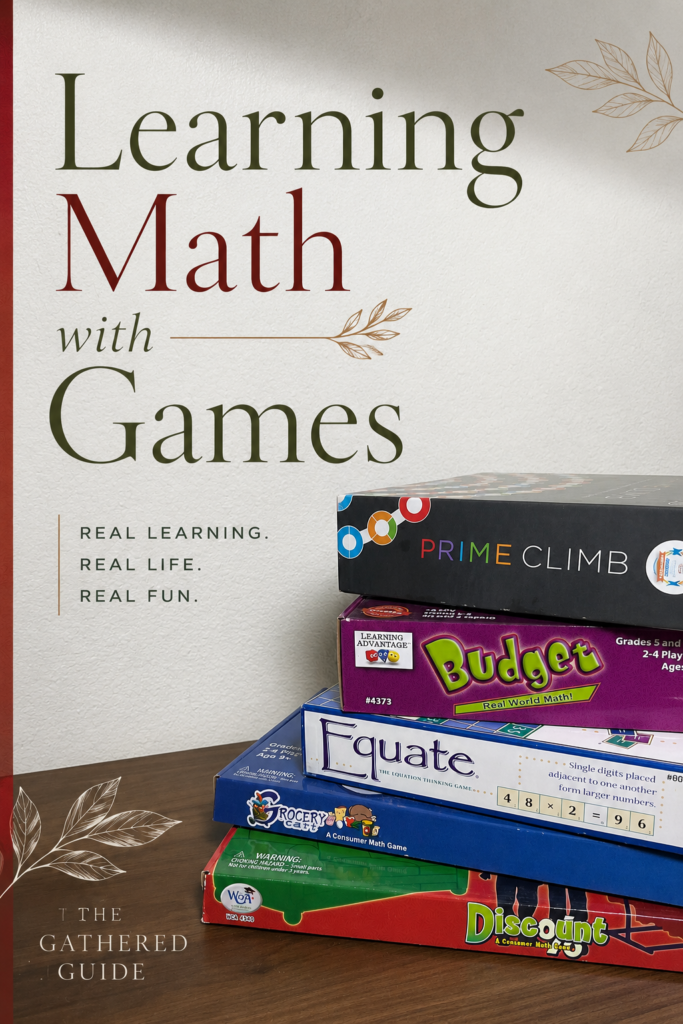
Prime Climb
Prime Climb was one of the very first games we bought specifically because I was looking for another way to approach learning. We were struggling with our math curriculum, math was becoming frustrating, and I finally thought, maybe we could just try a game instead.
So we tried Prime Climb—and my kiddo loved it.
Instead of sitting down for another frustrating math lesson, we were playing together while working with multiplication, division, factors, and prime numbers. It was one of the games that helped me realize that practicing math didn’t necessarily have to look like a traditional math lesson.
Good for: multiplication, division, factors, prime numbers, mental math, number sense, and strategy
Equate
Apparently I was being prepared for gameschooling long before I knew it. My mom was the queen of educational gifts—if she was buying you something, there was a pretty good chance you were going to learn something from it too. She was actually the one who gave us Equate.
Equate is essentially a math version of a word-building game. Instead of creating words with tiles, you build mathematical equations.
And I hated it. 😂
It just never clicked for me and I found it more frustrating than fun. We tried, but this wasn’t one that became a favorite in our house.
I’m still including it because that’s part of gameschooling too. Not every game is going to work for every family—or every brain. Sometimes you find Prime Climb. Sometimes you find Equate.
Good for: arithmetic, equations, mental math, and mathematical reasoning
Budget
Budget was one of our real-world math games.
Games involving budgeting give kids a reason to work with money beyond a contrived textbook question. You’re making choices, dealing with limited resources and seeing what happens when the numbers don’t work the way you hoped.
Good for: budgeting, money management, addition and subtraction, decision-making
Discount
Another one for the real-world math category. Discount brings percentages and consumer math into an actual shopping context.
Suddenly percentages aren’t just numbers on a worksheet—they’re connected to something kids will eventually encounter every time they see a sale sign.
Good for: percentages, discounts, consumer math, mental math
This is an older game and seems to be out of print, but we loved it. If it sounds like a game you want, you could check ebay.
Pool
Not all of our games came in a box. We also used playing pool as an excuse to explore geometry, angles, and even a little physics. You’re constantly thinking about where the cue ball needs to hit, what angle will send another ball toward the pocket, how balls will move after a collision, and how hard you need to hit the cue ball to get the result you want.
It was one of those situations where the concepts had an immediate purpose: figure out the angle, force, and movement correctly and you might actually make the shot.
Used pool tables can be surprisingly cheap on Facebook Marketplace because nobody wants to move them. We got ours that way and my kiddo and I somehow managed to get the entire thing out of the seller’s house and into ours by ourselves. I would check if it’s a slate top or wooden top, because that makes a huge difference. 😀
Good for: geometry, angles, spatial reasoning, force and motion, momentum, prediction, and problem-solving
Grocery Cart
Grocery shopping is practically a ready-made math lesson, and this game brings some of those same ideas to the table.
Good for: money, budgeting, addition, comparison shopping and practical math
This is an older game, and while we loved it, it can be hard to find now. If this sounds up your alley try checking ebay.
Yahtzee
Not every educational game needs “educational” printed on the box.
Yahtzee gives kids repeated practice with addition while also introducing probability, combinations and strategic decision-making.
Good for: addition, probability, number sense, strategy
Sequence Dice
Sequence Dice combines number work with the strategy and pattern recognition of Sequence. It is easy to take with you, but the full size game is a lot more fun.
Good for: basic arithmetic, number recognition, planning and strategy
TENZI
TENZI is ridiculously simple: everyone gets ten dice and races to roll all of them to the same number. There are tons of variations you can play, but at its heart it’s fast, easy, and involves a whole lot of dice rolling.
My kiddo loved this game. I, on the other hand, think ten dice per person repeatedly hitting the table is entirely too loud. 😂 But she loved it enough that I played anyway.
And underneath all that noise, kids are constantly recognizing numbers, counting, comparing what they have and thinking about probability without sitting down to “do math.”
We also had 77 Ways to Play TENZI, which gives you dozens of different challenges to play with the dice. That kept TENZI from being just one game and gave us lots of different ways to pull it off the shelf.
Good for: number recognition, counting, probability, mental processing, and quick decision-making
Language, Vocabulary & Storytelling Games
If you have a reluctant writer—or simply a kid who would rather play than complete another vocabulary exercise—games can provide an entirely different doorway into language.
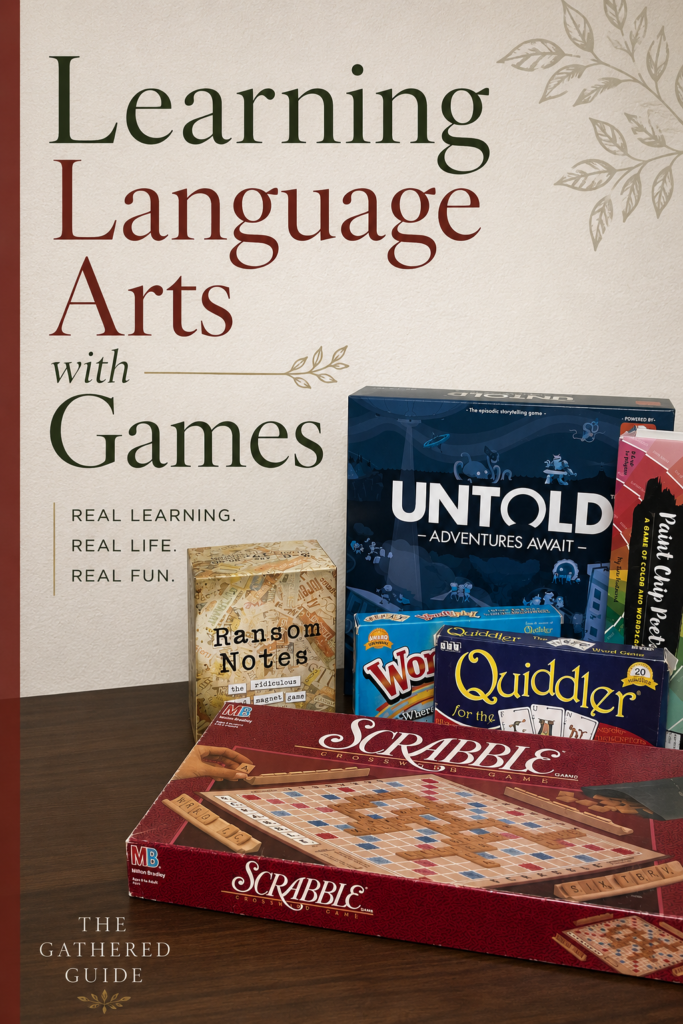
Scrabble
Scrabble was one I couldn’t wait to introduce to my kiddo because I grew up playing it with my mom. It was never one of my kiddo’s absolute favorites, but it has always been one of mine.
For homeschooling, the obvious benefits are spelling and vocabulary, but there’s plenty of strategy and mental math tucked in there too. You’re constantly rearranging letters, looking for possibilities, calculating scores and deciding whether to play a word now or hold onto those letters for something better.
Good for: spelling, vocabulary, word building, mental math and strategy
WordSpiel
Word games are especially easy to work into homeschool because kids are manipulating language without necessarily thinking of it as language practice.
WordSpiel is a quick and easy card game. Perfect for those times when you don’t have all afternoon to play a game, but want to have a little fun.
Good for: vocabulary, spelling, word building and flexible thinking
Pickles to Penguins
Pickles to Penguins is a quick-thinking picture-linking game where players have to find connections between seemingly unrelated things.
That’s a surprisingly useful language skill. You’re categorizing, making associations and—most importantly—explaining the connection you see.
Good for: verbal reasoning, categorization, vocabulary and creative thinking
Ransom Notes
Ransom Notes is a ridiculous word-magnet game that is much more about creativity than spelling drills, and that’s exactly why I like having games like it around.
Good for: wordplay, creative language, storytelling and thinking on your feet
Quiddler
Quiddler has been one of our absolute favorite word games—but apparently we’ve never really played Quiddler. 😂
Somewhere at the very beginning, we misunderstood the directions and started playing by our own rules. We played that way for so long that we didn’t realize anything was wrong until we eventually played with other people and they were basically like, “What are you doing?”
By then it was too late. We liked our version better, so we just kept playing it that way.
However you play it, Quiddler has you working with letters and building words, so there’s a lot of spelling and vocabulary happening while you’re trying to figure out what you can make from the cards in your hand.
Good for: spelling, vocabulary, word building, letter patterns, and flexible thinking
Paint Chip Poetry
Paint Chip Poetry gives you words and phrases inspired by paint-color names and challenges you to turn them into poems. It takes away that intimidating “write a poem about anything” blank page by giving you something to start with.
It’s also a fun way to see how completely different pieces of writing can come from the same handful of words.
Good for: poetry, creative writing, word choice, imagery and playing with language
Geography, History & Social Studies Games
This may be my favorite category because games can make places, people and events feel considerably more tangible than memorizing lists.
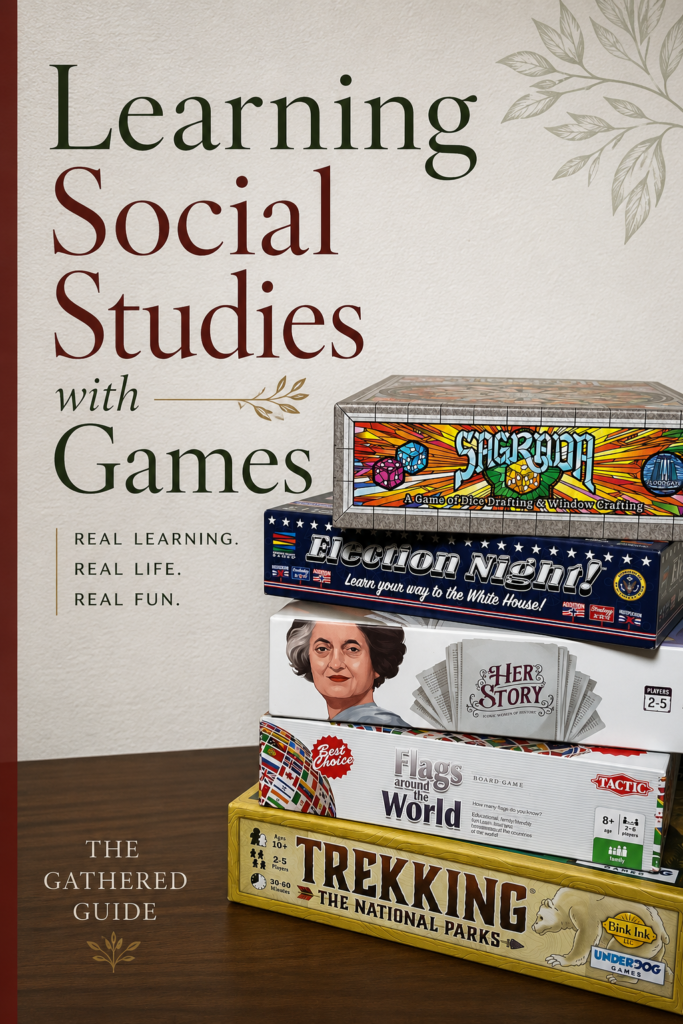
HerStory
HerStory focuses on notable women throughout history, giving kids an opportunity to encounter people who may only get a paragraph—or no mention at all—in a traditional history curriculum.
Good for: women’s history, biography and historical curiosity
And this is exactly the kind of game that can become a jumping-off point. Someone interesting appears in the game? Go find a biography, documentary or podcast about her.
Availability Note: HerStory appears to be harder to find now, but copies can still turn up at specialty game stores and secondhand.
Trekking the World
A game about traveling around the world naturally creates opportunities to talk about countries, landmarks and geography.
Good for: world geography, landmarks, cultures and map awareness
Sagrada
Sagrada is a gorgeous dice-placement game inspired by the stained-glass windows of the Sagrada Família in Barcelona, Spain. The game itself involves plenty of logic, pattern recognition, spatial reasoning, and strategy—but that’s not where the learning stopped for us.
Once we realized the game was based on a real place, down the rabbit hole we went. We ended up on YouTube learning about the Sagrada Família, Antoni Gaudí, Barcelona, the architecture, and the incredible story of a basilica that’s been under construction since 1882.
And that, to me, is gameschooling at its best. The game doesn’t have to teach the entire lesson. Sometimes it just needs to make someone curious enough to ask the next question.
Good for: geography, history, architecture, art, logic, spatial reasoning, patterns, and strategy
Trekking the National Parks
Trekking the National Parks took us well beyond simply learning the names and locations of the national parks. We’d look at the map and start trying to figure out trips we could take someday. Could we visit these three parks on the same trip? What route would we take? What other park could we add while we’re there?
Without really thinking about it as a “lesson,” we were working with U.S. geography, maps, distances, route planning and problem-solving—and dreaming up some pretty great road trips in the process.
Good for: U.S. geography, map skills, route planning, spatial reasoning and problem-solving
Flags of the World
We bought Flags of the World during an Olympic year because I thought it would be fun to recognize the countries by their flags while we watched the Olympics.
And it worked.
We started recognizing flags as they came across the screen and connecting them with the countries they represented. Even now, years later, we’ll see that bright green Brazilian flag with its yellow diamond and immediately go, “Brazil!”
The Olympics gave us a reason to care about learning the flags, and the game gave us a fun way to learn them. From there, it was easy to start noticing where those countries were located and becoming curious about the places and people represented by them.
Good for: world geography, countries, flags, visual memory, and cultural awareness
Election Night!
Election Night turns electoral politics into something kids can actually manipulate and watch unfold.
Depending on the age of the student, it can open conversations about the Electoral College, states, elections and how American government works.
Good for: civics, U.S. geography, elections and government
Science & Nature Games
We didn’t have nearly as many games that fit neatly into a traditional “science” box, but several encouraged observation and curiosity about the natural world.
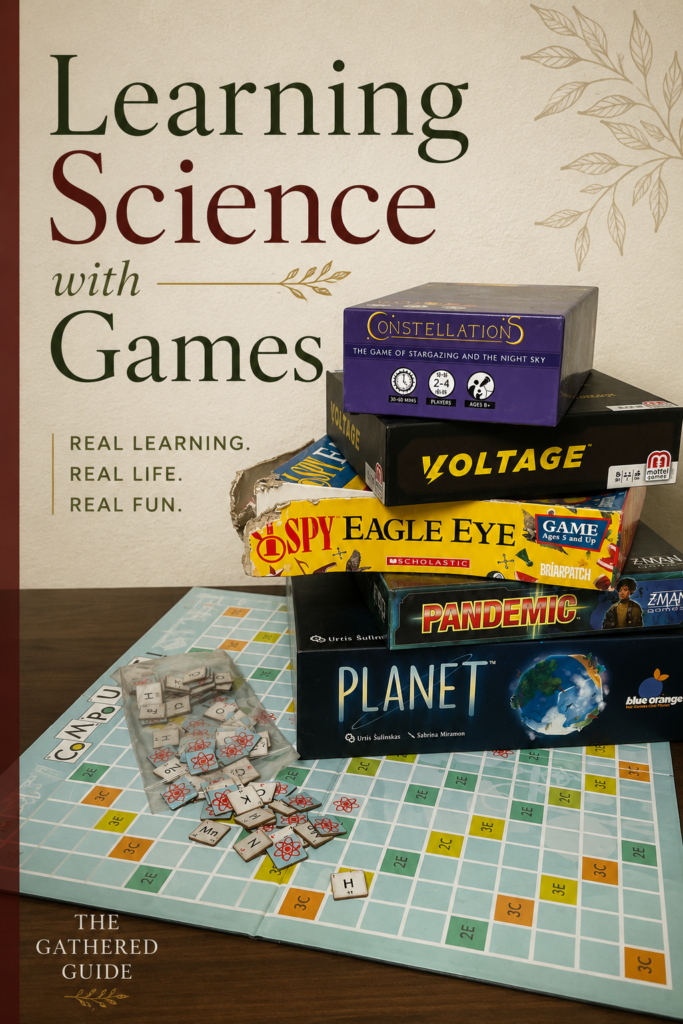
Planet
Planet is particularly interesting because you’re literally building a three-dimensional world and creating habitats for wildlife.
It naturally opens conversations about ecosystems, habitats and why particular animals live where they do.
Good for: ecosystems, habitats, animals, environmental science and spatial reasoning
Constellations
A natural companion for astronomy studies, especially for kids who become fascinated by identifying what’s actually in the night sky.
Good for: astronomy, constellations and night-sky observation
Availability Note: unfortunately it seems this one is getting hard to find as well.
I Spy Eagle Eye
Observation is an underrated scientific skill, and that’s what I Spy Eagle Eye is all about.
Learning to notice small details, compare visual information and search systematically is useful well beyond this particular game. And who doesn’t love to bang the bell first?!
Good for: observation, visual discrimination, attention to detail and pattern recognition
Pandemic
Pandemic is a cooperative game where everyone works together to stop diseases from spreading around the world. Players have different roles and have to coordinate their actions, travel between cities, contain outbreaks, and ultimately find cures.
It’s obviously a strategy game, but there’s a lot here to spark conversations about geography, how diseases spread, epidemics and public health. And because everyone wins or loses together, it also requires a surprising amount of communication and collaborative problem-solving.
Good for: biology, epidemiology, world geography, systems thinking, strategy, cooperation, and problem-solving
Logic, Strategy & Spatial Thinking
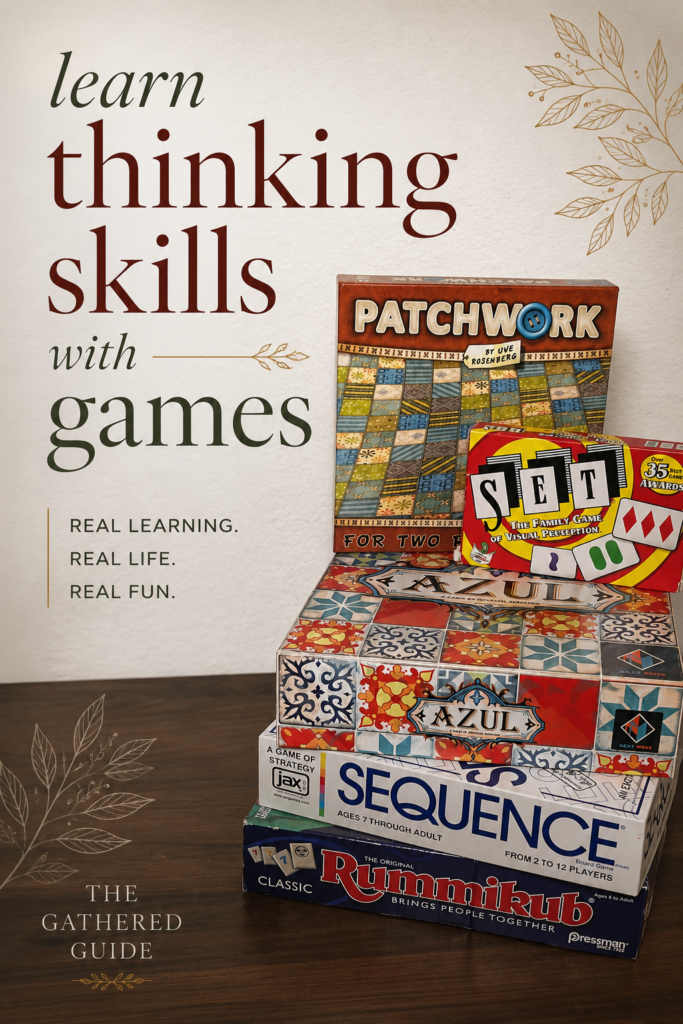
This is the category I wouldn’t leave out simply because it doesn’t correspond neatly to a school subject.
Planning ahead, changing strategies when something doesn’t work, recognizing patterns and visualizing how pieces fit together are all valuable thinking skills.
Blokus
Blokus is wonderfully simple to learn and increasingly difficult to play well.
Good for: spatial reasoning, geometry, planning, logic and strategy
SET
SET was actually really hard for us to get our heads around at first. You’re looking for groups of three cards where each characteristic—color, shape, number and shading—is either all the same or all different, and initially we just could not see the sets.
What finally helped was using an online version of the game. We played that for a while because it made it easier to start recognizing what counted as a set. Eventually something clicked, and we could go back to the physical card game and actually see the patterns we had been missing before.
That experience alone made SET interesting from a learning perspective. We weren’t memorizing an answer—we were essentially training ourselves to recognize increasingly complex visual patterns until our brains started spotting them.
Good for: pattern recognition, classification, visual perception, logical reasoning, and flexible thinking
Azul
Players build patterns with colorful tiles while simultaneously paying attention to what other players are doing. Azul is a beautiful game we played over and over.
Good for: patterns, spatial reasoning, planning and strategic thinking
Patchwork
We actually bought Patchwork while we were learning about the Underground Railroad and quilting. I thought a quilting-themed game would be a fun way to extend what we were already exploring without turning it into another assignment.
The game itself isn’t about the Underground Railroad. You’re building a patchwork quilt from differently shaped pieces, trying to fit everything together efficiently while managing your buttons and the space on your board. So while it complemented what we were learning about quilting, the actual gameplay brought in spatial reasoning, planning, problem-solving, and even a little resource management.
Good for: spatial reasoning, planning, problem-solving, patterns, and connecting play with a larger unit of study
Sequence
Sequence combines cards and a game board in a way that encourages players to recognize patterns while simultaneously watching—and interfering with—what their opponents are building.
Good for: strategy, pattern recognition and planning
Rummikub
Rummikub is another longtime favorite that asks players to recognize and manipulate numerical patterns.
Good for: number sense, sequencing, patterns, flexible thinking and strategy
Qwirkle
Qwirkle uses colors and shapes rather than numbers or words, making the underlying pattern recognition particularly visible.
Good for: patterns, classification, spatial reasoning, logic and strategy
Cribbage
Cribbage sneaks an enormous amount of mental arithmetic into a traditional card game.
Good for: mental math, combinations, addition, strategy and probability
Othello
Othello is one of the relatively few games from our homeschool shelves that we still pull out and play. The rules are simple, but playing it well requires you to think several moves ahead. One move can completely change the board, so you’re constantly watching for patterns, anticipating what the other player might do, and adjusting your strategy.
It’s a great example of a game that doesn’t look remotely “educational,” but requires an incredible amount of thinking.
Good for: logic, strategy, spatial reasoning, pattern recognition, planning ahead, and flexible thinking
Skip-Bo
I was playing Skip-Bo long before I ever thought about homeschooling—I used to play it with my friends in college. Years later, it became one of my kiddo’s favorite games, and it’s another one we still play.
The goal is to build piles of cards in numerical order, so there’s plenty of number sequencing happening naturally. But there’s also quite a bit of strategy involved in deciding which cards to play, which ones to save, and how to set yourself up for future turns.
Good for: number sequencing, numerical order, strategy, planning ahead, and logical thinking
What About Games That Aren’t “Educational”?
Some of the games on our shelves don’t fit into any school subject at all—and I think that’s worth saying.
A child playing a strategy game is practicing planning and adapting. A storytelling game requires communication and imagination. A game involving limited resources forces decision-making. Even learning to lose, wait for a turn, follow complicated rules and play fairly with other people has value.
You don’t have to justify every game by attaching a curriculum standard to it.
Sometimes playing a good game is enough.
How We Used Games in Our Homeschool
I don’t think game-based learning needs to become another complicated homeschool system.
You don’t need a spreadsheet matching every game to a standard or a carefully planned “game-schooling curriculum.”
Pull out Equate when you’re working on math. Play Trekking the World while you’re studying geography. Let HerStory send you down a rabbit hole about a woman you’ve never heard of. If somebody becomes fascinated by constellations after playing a game, go outside that night and look for one.
That’s one of the great advantages of homeschooling:
Learning doesn’t have to stay inside the subject you started with.
A game can be the lesson.
Or it can simply be the thing that sparks the next question.
And sometimes, the question is where the best learning begins.