A Bluebird Showed Up — Now What?
After seeing my first bluebird here in eight years, I had questions. A lot of questions.
This guide contains affiliate links, which means The Gathered Guide may earn a small commission if you make a purchase – at no additional cost to you.
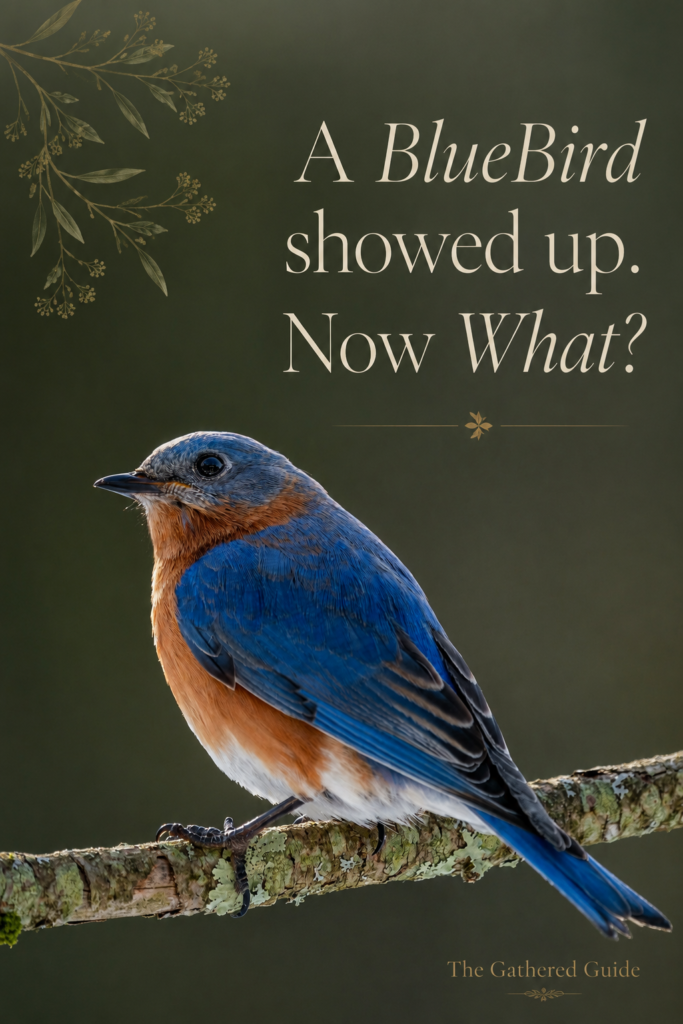
Yesterday afternoon, I spotted something I haven’t seen at my house in eight years: a bluebird.
Of course, I couldn’t simply think, Oh, that’s nice.
I immediately wanted to know: Why now? Did I accidentally do something that attracted it? Is it just passing through? Can I convince it to stay? What does it eat? Does it use a regular bird feeder? Should I put up a bluebird house?
And, because curiosity rarely travels in a straight line around here, I also ended up wondering why bluebirds have become such powerful symbols of happiness and hope.
So, down the rabbit hole we go.
Why Did a Bluebird Suddenly Show Up?
In my case, the answer may be surprisingly simple: my horse pasture is pretty close to ideal bluebird habitat.
Eastern Bluebirds like open areas with scattered trees and relatively short or sparse ground cover. Pastures, agricultural fields, meadows and other open spaces are exactly the kinds of places where you’re likely to find them.
Rather than spending their day digging through a bird feeder, bluebirds often sit on a fence post, wire or low branch watching the ground. When they spot something tasty, they drop down, grab it and return to a perch.
Suddenly the short grass, horse pastures and miles of fence posts around here look a little different.
I may not have intentionally created bluebird habitat.
But apparently I did.
What Do Bluebirds Eat?
For much of the year, Eastern Bluebirds are serious insect eaters.
They eat things like grasshoppers, crickets, beetles, caterpillars and spiders. In fall and winter, fruit and berries become a much larger part of their diet, including things such as sumac, hackberries, dogwood berries, wild cherries and juniper berries.
That also explains why an open pasture can be so appealing.
Short grass makes it easier for a bluebird sitting on a fence post to spot insects moving around below.
And considering the number of Kansas grasshoppers currently living on my property, I appear to be running an accidental all-you-can-eat bluebird buffet.
Do Bluebirds Eat From Bird Feeders?
They can, but bluebirds aren’t your typical seed-feeder customers.
Cornell notes that Eastern Bluebirds don’t commonly visit feeders unless the feeder offers mealworms.
That means the sunflower seed and regular birdseed at your feeding station may attract plenty of other birds without doing much to impress a bluebird.
Mealworms are another story.
Audubon recommends both live and freeze-dried mealworms for bluebirds, although live mealworms are especially useful during nesting season because they provide moisture as well as protein.
What Kind of Feeder Do Bluebirds Like?
A shallow tray or dish can work for offering mealworms, but there are also feeders made specifically for bluebirds.
Many bluebird mealworm feeders use a cage or enclosure that allows smaller birds to reach the food while making it harder for larger birds to clean everything out first. Audubon specifically recommends hopper-style or cage-style mealworm feeders for this reason.
So if your goal is specifically to encourage bluebirds, I wouldn’t start by buying another traditional seed feeder.
I’d start with mealworms and somewhere easy for them to find them.
Does Water Help Attract Bluebirds?
Yes — and this connects beautifully with another bird-watching rabbit hole I’ve been exploring lately: moving water.
Bluebirds need fresh water for drinking and bathing, and providing water along with food and appropriate habitat can help make a property more inviting to them.
A shallow birdbath is useful on its own. Add movement with a small fountain, bubbler or dripper and you’re creating another reason for birds exploring the area to stop and investigate.
Food gets a lot of attention in backyard birding, but sometimes water is the thing your yard has that the yard next door doesn’t.
Should You Put Up a Bluebird House?
This is where things get really interesting.
Bluebirds are cavity nesters. In nature, they use things like old woodpecker holes and natural cavities in trees. They also readily use properly designed nest boxes. Loss of natural nesting cavities contributed to historic bluebird declines, and nest boxes have played an important role in their recovery.
If you’ve got open land that bluebirds already seem interested in, putting up an appropriate bluebird house makes a lot of sense.
But where you put it matters.
Don’t Automatically Put the Bluebird House Beside Your Feeders
This was the part that changed my own plan.
My first instinct would have been to add the bluebird house to my existing bird feeding station.
That’s where the birds are, right?
Except a bluebird nest box may be much better placed out near the open area the bluebirds actually want to use.
Bluebirds hunt over open ground and regularly use fence posts and low perches while looking for insects. Cornell specifically recommends nest boxes where there is enough open space rather than in yards hemmed in by buildings or heavy tree cover.
So instead of automatically making the birdhouse another piece of your feeding station, look around your property.
Where is the short grass?
Where are the open sight lines?
Where are the fence posts or scattered trees?
Where are the insects?
That may be where your bluebird house belongs.
For me, the answer is looking a whole lot like the edge of a horse pasture.
Will Bluebirds Stay All Year?
Eastern Bluebirds can be present through much of their range year-round, although some populations move seasonally and birds may wander into different habitats during winter.
They can also raise more than one brood in a year. Cornell reports one to three broods, which means a summer bluebird isn’t necessarily simply passing through.
There could already be bluebirds nesting somewhere nearby.
The one you suddenly noticed might simply be the one that finally made you realize they were there.
What Does Seeing a Bluebird Mean Spiritually?
This is where natural history wanders into folklore.
Bluebirds have a remarkably long association with happiness, hope and good health in American culture. The Smithsonian Environmental Research Center describes bluebirds as longstanding symbols of all three.
That’s where the familiar idea of the “bluebird of happiness” comes from.
I tend to think we can enjoy symbolism without needing to decide that every bird was personally dispatched by the universe with a memo attached to its foot.
But I also think there’s something beautiful about noticing when an animal appears at a meaningful moment.
I hadn’t seen a bluebird here in eight years.
And then, one appeared.
Sometimes the meaning can simply be:
Pay attention. Something beautiful is here.
How Do You Encourage Bluebirds to Stay?
After going down this entire rabbit hole, my plan is surprisingly simple.
I’m not going to completely redesign my property for bluebirds.
I’m going to work with what is already attracting them.
Keep some open, short-grass areas where they can hunt.
Leave useful perches such as fence posts.
Avoid unnecessary insecticide use so there is actually something for insect-eating birds to eat.
Offer mealworms.
Provide fresh water.
And put a properly designed bluebird nest box in the habitat the bird actually wants to use — rather than simply hanging it wherever it looks cutest.
Then I’ll watch.
Because that may be my favorite part of learning more about the birds around us.
Once you understand what they’re doing, you start seeing your own backyard differently.
Yesterday that fence post was just a fence post.
Today?
I’m checking it for bluebirds.
Shop the Guide…
Everything featured in this guide is organized in one Amazon collection to make it easy to find everything you need to help keep your bluebirds around.